Applying FinOps to Device Fleets

Most of a device’s ongoing cost is set before it leaves the factory. Because a fleet stays in the field for five to ten years, early choices in hardware, connectivity, and maintenance compound over time.
Cloud teams already manage cost this way. The same method works for a device fleet. Only the cost drivers differ:
| Cloud | Fleet | |
|---|---|---|
| What you measure | A server, a request, a user | One device, over its whole service life |
| What costs money | Compute, storage, network | Hardware, connectivity, licenses, people, cloud |
| When something breaks | Software restarts it | A technician drives out |
| How long you pay | Month to month | Five to ten years |
What FinOps Is #
The method is called FinOps. The FinOps Foundation defines it as “an operational framework and cultural practice which maximizes the business value of technology.” Its scope now covers all technology spend, not only cloud.1 In practice, FinOps turns cost into an engineering metric rather than a quarterly surprise. In the cloud, every technical choice shows up on next month’s invoice. FinOps measures that cost per unit of business, such as cost per customer.2 For a fleet, the unit is one device per month.
What Changes for a Device Fleet #
A device’s costs are usually scattered across several budgets. Hardware is a purchase order. Connectivity is a carrier contract. Engineers are headcount. Repairs are service tickets. Because each has its own owner and billing cycle, the true cost of running a device is rarely visible in one place.
Fleet size changes which cost hurts most. Some costs are charged per device. Others are shared across the fleet.
Costs charged per device:
- Hardware. Assume $500 to $1,000 per device. An NVIDIA Jetson Orin NX module, for example, lists at $799.3 Spread the purchase price over the service life. Over five years, that is about $8 to $17 a month. Edge devices often stay in service for many years, past the end of vendor support.4
- Connectivity. Each device needs a cellular plan. One European provider lists about $1 a month to keep a SIM active, plus roughly $0.10 to $0.60 per megabyte depending on coverage.5 A device sending 10 megabytes a month costs about $2. Prices vary by region and contract. One analyst firm found the price of a megabyte ranging from half a cent to 14 cents.6
- Licenses. Many commercial platforms charge by device count, every month. Mender’s hosted update service lists $34 a month for up to 50 devices and $291 a month for up to 250. Its open-source version is free to host yourself.7
- Cloud. The bill follows how much data each device sends.
Costs shared across the fleet:
- Engineers. One engineer at $150,000 a year costs $1,250 per device per month across 10 devices. Across 1,000 devices, $12.50. Across 100,000, about 13 cents.
Costs that depend on how often things break:
- Repairs on site. Industry estimates put a technician visit at $150 to $500, and about $1,000 once indirect costs are included. No verified benchmark exists, so calculate your own.8 Then multiply by how often devices fail. One estimate puts annual hardware failures at 3% to 5% of a fleet.3 If 5% of devices need a $300 visit each year, that is $1.25 per device per month.
How Costs Change With Fleet Size #
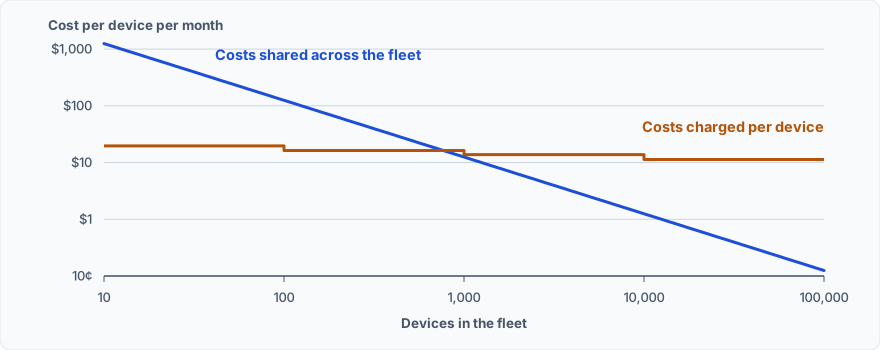
Costs shared across the fleet #
This is the engineering team. Its cost stays the same at any fleet size, so every added device makes it smaller per device.
Costs charged per device #
These are hardware, licenses, and connectivity. They are paid again for every device, so they get cheaper only through volume discounts.
Crossover point #
At small fleet sizes, engineering is the larger cost per device. At large sizes, hardware, licenses, and connectivity are. The fleet size where the two lines meet depends on your own prices.
A bundled vendor platform fits at 10 devices. At 1,000, its per-device fees add up, and leaving it can mean replacing hardware, tooling, and contracts together. Software that moves across hardware costs more engineering time at the start and keeps the choice of hardware and vendor open. Open-source tools support this: Yocto builds custom Linux images, and Mender updates devices remotely.
Where It Doesn’t Apply #
Small fleets don’t need this. Twenty devices on a bundled platform, with no plan to grow? The analysis costs more than it saves. Revisit it as the fleet nears your own crossover point.
Some fleets are cloud-heavy. Devices that stream video or send data to retrain models make the cloud bill the biggest cost. That bill follows how much data each device sends. So an average per device can mislead: ten busy devices can cost more than a thousand quiet ones.
Why It Matters Before You Scale #
When costs sit in separate budgets, nobody owns the unit economics of the device. Viewing them together as a single monthly cost per device changes how engineering and product teams make decisions:
- Hidden costs become visible. A rough total across hardware, SIMs, licenses, and site visits shows more than an exact cloud bill ever will.
- Scale surprises show up early. Modeling unit cost as the fleet grows reveals when per-device fees will overtake engineering headcount.
- Architecture becomes a financial choice. A license tier, a cellular payload size, or whether a bug requires a technician visit each carries a multi-year price tag. Seeing that cost before launch is cheap; discovering it at 1,000 devices is expensive.
References #
What is FinOps?: FinOps Foundation definition and scope. ↩︎
Unit Economics and Cost-to-Serve: FinOps Foundation guidance on unit economics. ↩︎
Edge AI Inference: GPU Deployment at the Network Edge: ClusterBid on edge hardware list prices and fleet failure rates. ↩︎ ↩︎
Network edge devices still widely used after reaching end-of-life status: Cybersecurity Dive on a VulnCheck report about edge devices that stay in service without firmware updates. ↩︎
Pricing: Open M2M list prices, excluding tax: €0.82 a month per SIM and €0.10 to €0.50 per megabyte, with discounts of 5% to 10% above 100 active SIMs. Dollar figures in the text are approximate conversions. ↩︎
IoT pricing: trends and analysis: Analysys Mason on the spread in publicly listed IoT tariffs. ↩︎
Plans and pricing: Mender list prices for hosted and open-source plans. ↩︎
What is a Truck Roll?: VSight, which states that no verified industry benchmark exists, reports the commonly repeated estimates, and gives a formula for building your own. ↩︎