Local LLM Inference
A benchmark score says how well a model answers. It does not say how much memory the model holds under load, how many users one machine serves, or what clients see when it fails. Those answers decide whether a local model belongs in production. I am evaluating them up front: the footprint, the capacity, and the failure behavior of a local model run as a service.
Why It Matters #
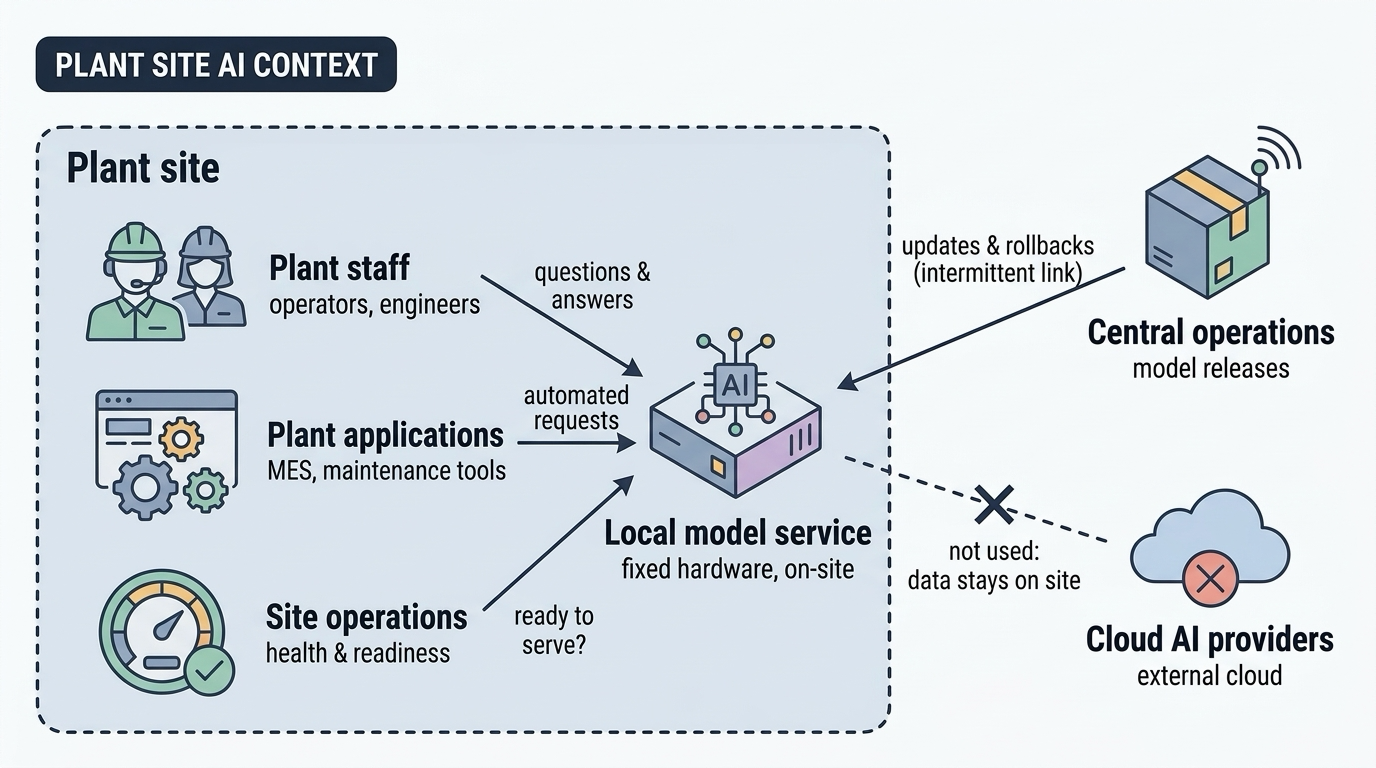
Industrial plants and edge sites often cannot send their data to a cloud API, because of data residency rules, customer contracts, or an unreliable uplink. They run on fixed hardware that nobody upgrades mid-deployment, often with intermittent connectivity and little physical access. A model there must behave like every other service on the box: sized in advance, predictable under load, and recoverable without a technician on site. The same constraints shape offline-resilient observability for edge fleets, and they apply here.
Open Questions #
- Footprint. How much GPU memory, system memory, and disk does a model need? How do context size and quantization change that?
- Capacity. How many concurrent requests can one machine serve before latency becomes unusable? What happens when the model does not fit on the GPU?
- Failure. How do I tell a healthy service from one that is only running? How long does it take to recover from a restart?
- Updates. How do I ship a model file of several gigabytes to a site over an intermittent link? How do I roll back when the new model misbehaves?
Current Status #
I have a working setup on my own hardware. The next step measures footprint and capacity across candidate models, then tests how the service fails and recovers. The goal is a set of sizing rules and an operating contract that a team can apply before it deploys a local model.